














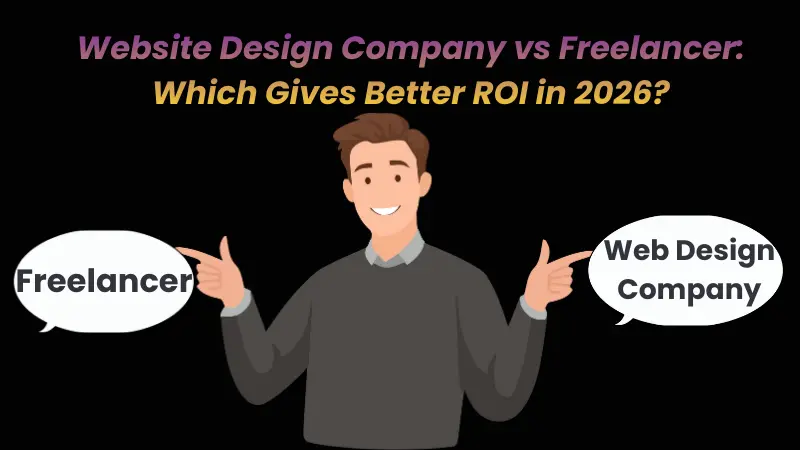

Website Design Company vs Freelancer: Which Gives Better ROI in 2026?
You need a website. That much is clear. But here's where it gets tricky: do you hire a freelancer who charges $500, or do you go with a web design company that quotes $5,000?
Both will promise you a stunning website. Both will show you portfolios that look professional. But six months down the line, one option might leave you scrambling to fix bugs at 2 AM, while the other keeps your site running smooth as butter.
I've seen businesses make both choices. Some thrive. Some regret it badly.
Let's break down which option actually gives you better ROI in 2026, because spoiler alert: the cheaper option isn't always the smarter one.
The Real Cost Nobody Talks About
Before we dive into freelancer vs agency, let's talk about something most people ignore until it's too late: hidden costs.
That $500 freelancer quote? It rarely stays $500. You'll need:
- A domain name and hosting (add $100-200/year)
- Premium plugins or themes (another $50-300)
- SSL certificate for security (sometimes included, sometimes not)
- Email setup and maintenance
- Future updates and bug fixes
Suddenly, that budget-friendly freelancer isn't looking so budget-friendly.
On the flip side, a website design company usually bundles these costs upfront. You know exactly what you're paying for. No surprises three months later when your contact form stops working.
Freelancers: The Good, The Bad, The "Where Did They Go?"
The Advantages
Let's be fair. Freelancers can be absolutely fantastic. Here's why businesses choose them:
Lower Initial Investment: A decent freelancer might charge anywhere from $500 to $3,000 for a basic business website. That's significantly less than most agencies.
Direct Communication: You're talking straight to the person building your site. No account managers. No back-and-forth emails through multiple people.
Flexibility: Good freelancers can pivot quickly. Need a last-minute change? They can usually accommodate faster than a company with established processes.
Specialized Skills: Some freelancers are absolute wizards at specific platforms. If you need a Shopify store design and find someone who lives and breathes Shopify, that's gold.
The Disadvantages
But here's what nobody mentions in those glowing testimonials:
Availability Issues: Freelancers get sick. They take vacations. They juggle multiple clients. Your urgent fix might wait until next Tuesday.
Skill Limitations: One person can't be expert-level at everything. Your freelancer might nail the design but struggle with SEO optimization or fail at making your site load fast.
The Disappearing Act: I've talked to at least a dozen business owners who hired a freelancer, loved the initial work, then couldn't reach them six months later when something broke. No contract. No backup. Just gone.
No Safety Net: If your freelancer misses a deadline or delivers subpar work, you're stuck. There's no team to pick up the slack.
Limited Scalability: As your business grows, can your freelancer handle a full website redesign while managing your email marketing and updating your blog? Probably not.
Website Design Companies: When The Investment Actually Pays Off
Now let's talk about the other side. Professional web design companies typically charge $3,000 to $15,000+ for a business website. Feels steep, right?
But here's what you're actually paying for.
The Real Advantages
Complete Team Access: You're not getting one person. You're getting designers, developers, content writers, SEO specialists, and project managers. Each person handles what they do best.
Accountability and Contracts: Companies have reputations to protect. They provide contracts, timelines, and guarantees. If something goes wrong, there's a clear process to fix it.
Long-Term Support: Most web design agencies offer maintenance packages. Your site breaks at midnight? There's a support system in place.
Strategic Approach: Companies don't just build websites. They analyze your competitors, research your audience, and create a digital marketing strategy that actually drives results.
Scalability: Need to add an e-commerce section? Want to integrate with your CRM? Companies have the resources to handle complex projects without breaking a sweat.
Quality Assurance: Multiple people review your site before launch. Bugs get caught. Design inconsistencies get fixed. Everything goes through proper testing.
The Downsides
It's not all sunshine and rainbows. Here's what makes businesses hesitate:
Higher Upfront Cost: No getting around it. Companies cost more initially. For a startup watching every dollar, that price tag stings.
Slower Decision Making: With multiple stakeholders involved, changes might take longer to implement compared to shooting a quick message to your freelancer.
Potential Over-Engineering: Some agencies push features you don't actually need because they want to justify their pricing.
Less Personal Touch: You might not develop that close working relationship you'd get with a dedicated freelancer.
The ROI Breakdown: Let's Do Some Math
Here's where things get interesting. Let's compare two scenarios over 24 months.
Scenario 1: The Freelancer Route
- Initial website cost: $1,500
- Hosting and domain: $200/year = $400
- Emergency fixes (average): $300
- Major update needed after 18 months: $800
- Lost revenue from 3 days of downtime: $500
- Total: $3,500
Scenario 2: The Design Company Route
- Initial website cost: $5,000
- Hosting included in maintenance package: $100/month = $2,400
- Emergency fixes: $0 (included in maintenance)
- Updates and improvements: Included
- Downtime: Minimal, handled quickly
- Total: $7,400
Wait, the company costs more? Yes. But here's what that doesn't show:
The professional website design typically converts 30-40% better because of proper UX research and optimization. If your website generates even $10,000 in revenue over those 24 months, a 30% improvement means an extra $3,000 in your pocket.
That company route just became cheaper in real terms.
When Freelancers Make Perfect Sense
I'm not here to bash freelancers. Sometimes they're exactly what you need.
You Should Hire a Freelancer If:
- You're a solopreneur or very small business with limited budget
- You have clear, simple requirements (basic brochure website)
- You're somewhat tech-savvy and can handle minor issues yourself
- You've found someone with verifiable reviews and a solid track record
- Your timeline is flexible
- You only need a landing page design or a simple portfolio website
Real Example: A local photographer needed a simple portfolio site. She hired a freelancer for $800. The site looks great, loads fast, and she hasn't had a single issue in 8 months. Perfect choice for her needs.
When Companies Are Worth Every Penny
On the flip side, some situations practically demand a professional team.
You Should Hire a Design Company If:
- Your website directly generates revenue (e-commerce, SaaS, services)
- You need ongoing digital marketing support beyond just the website
- Downtime would cost you real money
- You want a comprehensive SEO strategy built into your site from day one
- Your industry requires specific compliance or security standards
- You're planning to scale significantly in the next 1-2 years
- You need an ecommerce website with hundreds of products
Real Example: A medical equipment company needed an e-commerce site with HIPAA-compliant features and complex inventory management. They tried a freelancer first, wasted 6 months and $4,000, then hired a professional IT company. The proper site cost $12,000 but paid for itself in the first quarter.
The Hybrid Approach: Best of Both Worlds?
Here's something interesting happening in 2026: more businesses are using a hybrid model.
They hire a corporate website design company for the main site build and strategy, then use freelancers for ongoing content creation, minor updates, or specialized tasks like video editing.
This approach can work brilliantly if managed correctly. You get the reliability and expertise of a company for the foundation, then keep costs lower for day-to-day maintenance.
Red Flags to Watch For (Both Options)
Whether you're considering a freelancer or a company, watch out for these warning signs:
Freelancer Red Flags:
- No contract or incredibly vague terms
- Can't provide client references
- Extremely low prices (if it sounds too good to be true...)
- Poor communication from the start
- No clear process or timeline
- Uses only free themes without customization
Company Red Flags:
- Pushy sales tactics or "today only" pressure
- Won't show you their portfolio or case studies
- Vague about what's included in the price
- No clear point of contact
- Cookie-cutter approach with no strategy discussion
- Can't explain their process in simple terms
The 2026 Factor: What's Changed?
This year brings some new considerations that didn't matter as much before.
AI Tools: Both freelancers and companies now have access to AI design assistants and code generators. This levels the playing field somewhat, but companies still have the advantage of knowing how to use these tools strategically rather than just speeding up basic tasks.
Mobile-First Is Non-Negotiable: More than 60% of web traffic comes from mobile devices now. Companies typically have dedicated mobile UX specialists. Freelancers might just make your desktop site "responsive enough."
Core Web Vitals: Google's ranking factors are more technical than ever. Page speed, layout stability, and loading performance directly impact your SEO. Companies have the tools and expertise to optimize these. Many freelancers don't even test for them.
Privacy Regulations: GDPR, CCPA, and various other privacy laws keep expanding. Companies stay updated on compliance requirements. Freelancers might not even think about cookie consent banners until you bring it up.
Making Your Decision: 5 Questions to Ask Yourself
Before you decide, honestly answer these:
- What's your website's role? Is it just informational, or does it directly generate revenue?
- What's your technical comfort level? Can you handle basic troubleshooting, or do you need someone on call?
- What's your growth trajectory? Will you need significant changes in the next 6-12 months?
- What's your true budget? Not just upfront, but ongoing maintenance and marketing?
- How much is downtime worth? Calculate what a day of website problems would actually cost you.
Your answers will point you in the right direction.
The Verdict: ROI in 2026
Here's the truth: there's no universal answer.
For basic needs with a tight budget, a skilled freelancer absolutely makes sense. You'll save money upfront, and if you find the right person, you'll get a solid website that serves your needs.
But if your website is a critical business tool, if it generates revenue, if you're planning to grow, then a professional web design company delivers better ROI. The higher upfront investment pays for itself through better conversion rates, less downtime, ongoing optimization, and strategic support.
Think of it this way: a freelancer is like buying a reliable used car. A design company is like buying a new car with a warranty and free maintenance. Both get you where you need to go, but your choice depends on how far you're planning to drive and what happens if something breaks down on the way.
What Should You Do Next?
Start by getting quotes from both freelancers and companies. Be specific about your needs. Ask detailed questions about maintenance, support, and what happens if problems arise.
Most importantly, check their work. Look at actual sites they've built, not just mockups in their portfolio. Test those sites on your phone. See how fast they load. If possible, talk to their previous clients.
And remember: the cheapest option usually costs more in the long run, but the most expensive option isn't automatically the best either.
Your website is often the first impression customers get of your business. Choose wisely, whether that means a talented freelancer or a full-service company.
Need help figuring out the right approach for your specific situation? Get a free quote and let's talk through your options. Sometimes the best ROI comes from having an honest conversation about what you actually need versus what sounds good in theory.
Because in 2026, your website isn't just a nice-to-have anymore. It's your hardest-working salesperson, and it never takes a day off. You just need to decide who's going to build it right.
Frequently Asked Questions