













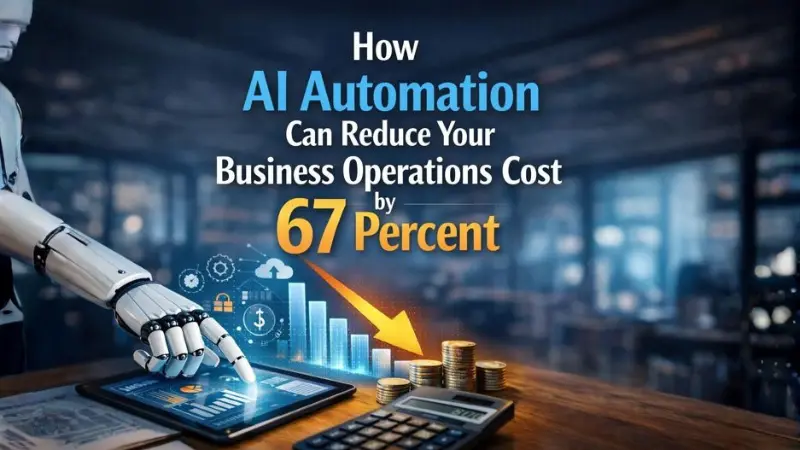

How AI Automation Can Reduce Your Business Operations Cost by 67 Percent
You know that feeling when you're paying your monthly business bills and wondering where all the money goes? Payroll, software subscriptions, overhead costs—they just keep piling up. What if I told you there's a way to cut those operational costs by more than half, and it doesn't involve firing half your team or moving to a cheaper office?
AI automation is doing exactly that for businesses right now. Not in some distant future, but today. Companies are seeing 50-67 percent reductions in their operational costs after implementing AI solutions. Sounds too good to be true? Let me show you how it actually works.
What Exactly Is AI Automation (And Why Should You Care)?
Before we dive into the cost savings, let's get clear on what we're talking about.
AI automation means using artificial intelligence to handle repetitive tasks that humans usually do. Think customer service chatbots, automated email responses, inventory management systems, or data entry tools that never sleep and don't need coffee breaks.
Unlike traditional automation (which just follows set rules), AI learns and improves over time. It's like having an employee who gets better at their job every single day without asking for a raise.
For small businesses especially, this is a game-changer. You're competing with companies that have way bigger budgets, but AI levels the playing field.
The Real Numbers: Where That 67 Percent Savings Comes From
Alright, let's break down where you actually save money. Because "67 percent" sounds impressive, but what does it mean for your bottom line?
1. Labor Costs Drop Significantly
This is the big one. Labor typically eats up 50-70 percent of operational budgets for service businesses.
AI doesn't replace your entire team (let's be clear about that). But it handles the boring, repetitive stuff so your team can focus on work that actually needs a human touch.
Real example: A digital marketing agency in Los Angeles used to have three people just managing client reports and data entry. After implementing AI tools, one person now oversees the system while the other two moved to client strategy work. That's not job loss—that's better job allocation.
The math: If you're paying $45,000 per year for someone doing data entry 6 hours a day, and AI reduces that to 2 hours, you've just saved roughly $30,000 annually on that one position.
2. Customer Service That Doesn't Sleep (Or Ask For Overtime)
Ever calculated what it costs to staff a customer service line 24/7? It's brutal.
AI chatbots now handle 60-80 percent of common customer questions without human intervention. They work nights, weekends, and holidays without complaining.
A business website design company I know integrated an AI assistant on their site. Their customer inquiry response time went from 4 hours to 4 minutes. Support ticket volume dropped by 70 percent because the AI resolved issues before they became tickets.
Cost breakdown:
- Traditional 24/7 support: 3 shifts × 2 people × $35,000 = $210,000/year
- AI chatbot with 1 human supervisor: $15,000 software + $45,000 salary = $60,000/year
- Savings: $150,000 (71% reduction)
3. Marketing Costs Get Slashed
Marketing used to mean hiring agencies or full-time specialists for every channel. Not anymore.
AI tools now handle email campaigns, social media scheduling, ad optimization, and even content creation. What used to require a team of five can now be managed by two people with the right tools.
Consider SEO services. Traditional SEO analysis took hours of manual work. AI tools now analyze your entire website, competitors, and keywords in minutes. Same quality, fraction of the time and cost.
4. Error Reduction Saves More Than You Think
Human errors cost money. Wrong orders, data entry mistakes, inventory miscounts—they add up fast.
AI doesn't get tired or distracted. An ecommerce website design platform using AI inventory management reduced stock errors by 94 percent. That's thousands saved on incorrect shipments, overstocking, and customer refunds.
5. Time = Money (And AI Gives You Both)
Let's talk about something businesses don't track well enough: time waste.
When your team spends 2 hours daily on tasks that AI could do in 2 minutes, you're hemorrhaging money. Those hours could go toward business growth, client relationships, or product development.
Quick calculation: If you have 10 employees spending just 1 hour daily on automatable tasks, that's 50 hours weekly or 2,600 hours yearly. At an average rate of $30/hour, you're looking at $78,000 in wasted labor costs.
Where AI Automation Works Best (The High-Impact Areas)
Not every task needs AI. Some things genuinely need that human touch. But here's where automation really shines:
Administrative Tasks
- Email sorting and responses
- Calendar management
- Data entry and processing
- Invoice generation
- Document organization
Customer-Facing Operations
- Initial customer inquiries
- Appointment scheduling
- Order tracking updates
- FAQ responses
- Feedback collection
Marketing & Sales
- Lead qualification
- Email campaign management
- Social media posting
- Ad performance optimization
- Sales pipeline tracking
Financial Operations
- Expense tracking
- Budget forecasting
- Payment processing
- Financial reporting
- Tax preparation assistance
Content & Creative Work
- Content writing drafts
- Graphic design templates
- Video editing basics
- Website updates
- Product descriptions
Real Businesses, Real Savings: Case Studies You Can Learn From
Let me share some actual examples (with permission, obviously).
Case Study 1: Local Medical Practice
A diagnostic center worked with experts in digital marketing to implement AI for appointment scheduling and patient follow-ups.
Before AI:
- 2 full-time receptionists handling calls and bookings
- 30% no-show rate for appointments
- 4-6 hours daily on reminder calls
After AI:
- 1 receptionist + AI scheduling system
- 8% no-show rate (AI sends automated reminders)
- More time for patient care
Total savings: $42,000 annually, plus better patient satisfaction.
Case Study 2: Photography Business
A camera club offering workshops used to manually handle all their marketing and bookings. After implementing AI tools, their organic traffic tripled while marketing costs dropped 60 percent.
They automated social media posts, email campaigns, and even basic photo editing workflows.
Case Study 3: E-commerce Store
A Shopify store selling handmade goods implemented AI for:
- Inventory predictions (reduced overstock by 80%)
- Customer service (chatbot handling 70% of inquiries)
- Email marketing (automated abandoned cart sequences)
Their operational costs dropped from $12,000/month to $4,500/month. That's 62.5 percent savings.
How to Actually Implement AI Without Breaking Your Business
Okay, you're sold on the idea. But where do you start? Here's the practical roadmap:
Step 1: Audit Your Current Operations
Spend a week tracking where time actually goes. Not where you think it goes—where it actually goes.
Ask your team:
- What tasks feel repetitive?
- What takes longest but adds least value?
- What would you automate if you could?
Step 2: Start Small (Please, Start Small)
Don't try to automate everything at once. That's how companies fail at this.
Pick ONE high-impact, low-risk area. Customer service chatbots are usually a safe bet. Or automated email marketing.
Get that working smoothly before adding more.
Step 3: Choose the Right Tools
There's a million AI tools out there. Here's what actually matters:
For customer service:
- Chatbots (Intercom, Drift, or custom solutions)
- AI phone assistants
For marketing:
- Email automation (Mailchimp, HubSpot)
- Social media schedulers
- AI content tools
For operations:
- Project management AI (Monday.com, Asana with AI features)
- Accounting automation (QuickBooks, Xero)
- Inventory management systems
For your website: Working with a web design company that understands AI integration can save you headaches. They'll build automation right into your site structure.
Step 4: Train Your Team (Not Replace Them)
This is crucial. AI works best when humans and machines collaborate.
Your team needs to understand:
- What the AI can and cannot do
- How to work with it
- How it makes their jobs easier (not threatens them)
When people see AI as a helpful assistant rather than a replacement, adoption goes way smoother.
Step 5: Measure Everything
You can't improve what you don't measure. Track:
- Time saved on specific tasks
- Error reduction rates
- Customer satisfaction scores
- Actual dollar savings
- ROI on AI tools
If something isn't working, adjust or cut it. Not every AI solution will fit your business.
Common Mistakes That Kill AI Automation ROI
I've seen businesses mess this up in predictable ways. Avoid these:
Mistake 1: Automating Bad Processes
AI makes processes faster, not better. If your process sucks, AI just makes it suck faster.
Fix your workflows first, then automate them.
Mistake 2: No Human Oversight
AI isn't perfect. It needs humans checking in, especially at first.
One company automated their customer responses and didn't review them for a month. The AI developed some weird quirks that annoyed customers. Easy fix, but embarrassing.
Mistake 3: Ignoring Your Industry's Specific Needs
Generic AI tools are fine for generic tasks. But your industry might need specialized solutions.
An IT company needs different automation than a restaurant. Do your homework.
Mistake 4: Forgetting About Security
AI tools access your data. Make sure they're secure and compliant with regulations in your industry.
This is especially critical for healthcare, finance, or any business handling sensitive customer information.
The Hidden Benefits Beyond Cost Savings
Here's what surprised me most about AI automation—the savings are just the beginning.
Your Team Actually Becomes Happier
Nobody dreams of spending their career doing data entry or answering the same questions 50 times daily.
When AI handles the boring stuff, your team focuses on interesting, meaningful work. Employee satisfaction goes up. Retention improves. That saves money too.
You Can Scale Without the Growing Pains
Traditional scaling means hiring more people, more management overhead, more complexity.
AI scales infinitely without the drama. You can handle 10,000 customers as easily as 1,000. Try doing that with just human labor.
Better Data = Better Decisions
AI doesn't just do tasks—it collects data on everything it touches.
That gives you insights you never had before. Customer behavior patterns, operational bottlenecks, market trends. It's like having a business analyst working 24/7.
Competitive Advantage
While your competitors are still doing things the old way, you're faster, cheaper, and more efficient.
That matters. A lot.
What About the Risks? (Yeah, Let's Talk About That)
I'm not gonna pretend AI automation is perfect. There are legitimate concerns:
Job Displacement Fears
This is the elephant in the room. Yes, some roles will change. But smart businesses use AI to upgrade jobs, not eliminate them.
Your data entry person becomes a data analyst. Your customer service rep becomes a customer experience specialist handling complex issues.
Initial Investment Costs
Good AI tools aren't free. Expect $100-$1,000+ monthly depending on what you need.
But remember—you're aiming for 50-67 percent savings. Even expensive AI pays for itself within months.
Learning Curve
Your team needs time to adapt. Budget for training and some initial productivity dips.
It's temporary, but it's real.
Technology Dependence
What happens if the AI system goes down? Have backup plans.
Don't put all your eggs in one automated basket.
Industry-Specific Applications (Because One Size Doesn't Fit All)
Different industries see different benefits. Here's a quick breakdown:
Retail & E-Commerce
- Inventory forecasting
- Dynamic pricing
- Personalized recommendations
- Automated reordering
Typical savings: 55-70%
Professional Services
- Client onboarding
- Document generation
- Scheduling and billing
- Research assistance
Typical savings: 40-60%
Healthcare
- Appointment management
- Patient communication
- Billing and coding
- Diagnostic assistance
Typical savings: 50-65%
Manufacturing
- Quality control
- Predictive maintenance
- Supply chain optimization
- Production scheduling
Typical savings: 60-75%
Marketing Agencies
- Campaign management
- Reporting and analytics
- Content creation
- Client communication
A good digital marketing agency in New York City or anywhere else can cut operational costs by 55-65% with smart AI implementation.
The Future Is Already Here (And It's More Accessible Than You Think)
Five years ago, AI was expensive and complicated. Only big companies could afford it.
Today? There's AI tools for every budget and every business size.
Small businesses especially should pay attention. AI is your chance to compete with bigger players without their massive overhead.
Whether you're running a portfolio website as a freelancer or managing a corporate website for a mid-sized company, automation can transform your operations.
Action Steps You Can Take This Week
Enough theory. Here's what to do right now:
Today:
- List your 5 most time-consuming repetitive tasks
- Research one AI tool that could help with the biggest one
- Calculate how much time (and money) you could save
This Week:
- Try one free AI tool in a low-risk area
- Get team feedback on pain points that could be automated
- Budget for AI implementation (even if it's just $50/month to start)
This Month:
- Implement your first automation
- Measure the results
- Plan your next automation project
This Quarter:
- Review all automated processes
- Calculate actual ROI
- Expand to new areas
The Bottom Line (Because That's What Matters)
Can AI automation really reduce your operational costs by 67 percent? Yes. I've seen it happen.
Will it work exactly that way for every business? No. Your mileage will vary based on your industry, current efficiency, and how well you implement it.
But here's what I know for sure: businesses that don't embrace AI automation in the next few years will struggle to compete with those that do.
The technology is here. It's affordable. It works.
The question isn't whether you should automate. It's how quickly you can start.
Frequently Asked Questions